

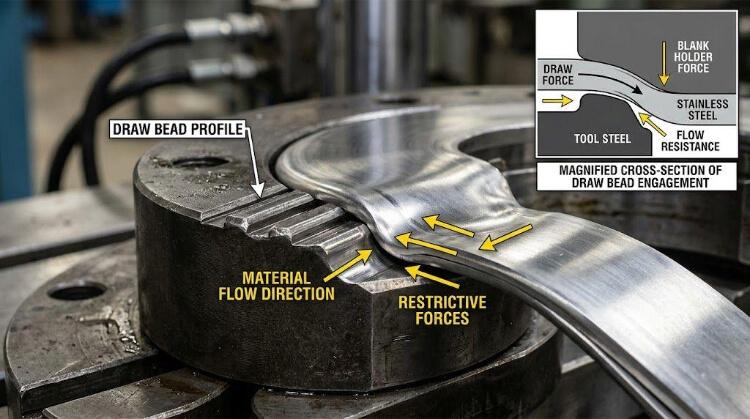
Deep drawing is a fundamental sheet metal forming process where a flat blank is radially drawn into a forming die by a mechanical punch, creating hollow cylindrical, rectangular, or complex cup-shaped components.
When working with stainless steel sheets—particularly austenitic 300-series grades—fabricators must account for high yield strengths, rapid work-hardening rates, and elevated friction forces that differ significantly from standard carbon steel or aluminum.
1. Material Behavior: Work Hardening and Formability
Austenitic grades (such as 304 and 304L) are the primary choices for deep drawing due to their high ductility and high ultimate tensile strength. However, their defining characteristic during deformation is a high work-hardening exponent ($n$-value).
$$\sigma = K \cdot \epsilon^n$$
Where:
- $\sigma$ = True Stress
- $K$ = Strength Coefficient
- $\epsilon$ = True Strain
- $n$ = Strain-Hardening Exponents ($n \approx 0.45\text{–}0.55$ for 304 stainless steel)
As the material stretches and deforms into the die cavity, its crystalline structure undergoes strain-induced transformation from austenite to martensite. This transformation significantly increases the local yield strength of the metal.
While work hardening prevents localized necking and thinning by distributing strain across the sheet, it requires significantly higher press tonnage and causes rapid tool wear.
2. Limiting Draw Ratio (LDR) and Blank Sizing
The formability of a stainless steel sheet is measured by its Limiting Draw Ratio (LDR), defined as the ratio of the maximum blank diameter ($D_{\max}$) that can be drawn into a cup without fracturing to the punch diameter ($d$).
$$\text{LDR} = \frac{D_{\max}}{d}$$
For Grade 304 stainless steel, the single-draw LDR typically ranges between 2.0 and 2.2. If a part requires a drawing ratio higher than this limit, the forming process must be divided into multiple reduction steps:
- First Draw: $40\%\text{–}45\%$ diameter reduction from blank to cup.
- Second Draw (Redraw): $20\%\text{–}30\%$ reduction of the previous cup diameter.
- Third Draw: $15\%\text{–}20\%$ reduction.
Interstage Annealing
When performing multiple deep-drawing operations, the severe work hardening accumulated during the first pass reduces ductility. To restore formability, the semi-formed parts must undergo interstage solution annealing at temperatures between $1010^\circ\text{C}$ and $1120^\circ\text{C}$, followed by rapid water quenching to dissolve strain-induced martensite back into soft, ductile austenite.
3. Die Clearance and Tool Design Guidelines
Because stainless steel exhibits high strength and a strong tendency to spring back, tooling clearance and punch/die radii must be calculated precisely:
| Tooling Parameter | Carbon Steel Benchmark | Stainless Steel Requirement | Technical Reason |
| Die Clearance | $107\%\text{–}110\%$ of sheet thickness ($T$) | $115\%\text{–}125\%$ of sheet thickness ($T$) | Accommodates sheet thickening at the cup rim and prevents die galling. |
| Punch Radius ($R_p$) | $4\times T \text{ to } 6\times T$ | $5\times T \text{ to } 8\times T$ | Prevents punch-line bottom tearing caused by stress concentration. |
| Die Entry Radius ($R_d$) | $4\times T \text{ to } 6\times T$ | $6\times T \text{ to } 10\times T$ | Reduces friction and radial tension during deep material flow. |
Tool Material Selection
To withstand the severe sliding contact pressures of deep drawing without pick-up or galling, dies are typically machined from:
- Tool Steels: D2, D3, or A2 hardened to $58\text{–}62 \text{ HRC}$ with TiN or TD coatings.
- Aluminum Bronze Alloys: Ampco 18 or 21 alloys (ideal for eliminating surface scratches on decorative components).
- Cemented Tungsten Carbide: Used for high-volume, long-run production dies.
4. Blank Holder Pressure and Wrinkling Control
The blank holder (or draw ring) applies a controlled clamping force to the outer periphery of the sheet to prevent structural wrinkling as the metal flows into the die cavity.
- Insufficient Pressure: Causes radial flange wrinkling as circumferential compressive stresses buckle the unrestrained sheet.
- Excessive Pressure: Restricts metal flow, increasing radial tensile stresses in the cup wall and causing wall rupture or bottom fracturing.
For austenitic stainless steel, typical blank holder pressures range between 2.5 MPa and 5.0 MPa, which is roughly $2\times$ to $3\times$ higher than pressures required for mild carbon steel sheets.
5. Lubrication Strategies
During deep drawing, extreme localized pressure generates intense frictional heat. Standard soluble oils fail under these conditions, leading to direct metal-to-metal contact (galling and die pick-up).
High-performance deep-drawing lubricants for stainless steel rely on:
- Chlorinated Extreme Pressure (EP) Additives: Form a sacrificial boundary film of iron chloride on the sheet under heat and high pressure.
- Pigmented Heavy Pastes / Synthetic Polymers: Utilize dry-film or high-viscosity synthetic barriers that maintain physical separation between the die surface and the stainless sheet.
- Polyethylene Film Application: Applying a thin plastic protective film directly onto the stainless sheet provides an excellent low-friction physical barrier during drawing and is removed post-forming without chemical washing.
Summary: Successful deep drawing of stainless steel sheets requires balancing high press forces, expanded die clearances ($115\%\text{–}125\% T$), generous tool radii, high blank holder pressures, and boundary lubricants to control severe work-hardening behavior and prevent galling.